The Document That Sold Itself
Coda spent three years building a document that could turn a blank page into a spreadsheet, a project tracker, or a full internal app. This flexibility was also its biggest liability, because nobody trusted it before they watched someone else fill it in first.
Key figure: 1M+
The number of users Coda said had built something on its platform by early 2022, according to its own product announcement.
The Blank Page Problem
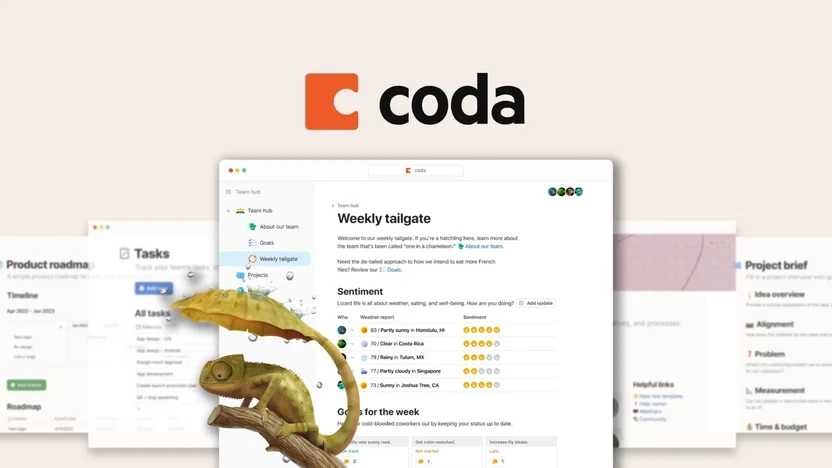
Shishir Mehrotra left YouTube in 2014 carrying an idea that doubled as an insult to the software industry: the documents and spreadsheets running every company hadn't meaningfully changed since the 1970s. He wanted to fix that with a single doc that could act as a spreadsheet, a project tracker, or a full internal app, all built from one blank canvas. He walked through the vision in an interview about his path from YouTube executive to founder. Then Coda did something almost no enterprise software company does: it completely disappeared for three years, building in near-total secrecy before a single outside user touched the product.
But when Coda finally decided to open its beta, the field was already littered with competitors who were making nearly identical promises: Notion had launched its own all-in-one workspace in 2016. Airtable had been selling flexible databases since 2012. Salesforce had already bought the word processor Quip, and Asana, while Atlassian, Google, and Microsoft all sat entrenched at the center of how teams already worked. Instead of entering an empty category, Coda was trying to break into the single most contested category in software, with a product that resisted being described in one sentence.
A doc that can become anything looks, in a five-minute demo or on a landing page, like nothing in particular. Ask ten prospective users what Coda does and you'd get ten different, half-finished answers. By 2017, Coda had recruited backers serious enough to put Greylock partner Reid Hoffman on its board, a ray of hope that showed sophisticated investors believed the vision. However, board-level conviction or not, they still had to solve the problem of a customer staring at their product with no idea where to start.
Let the Users Do the Pitching
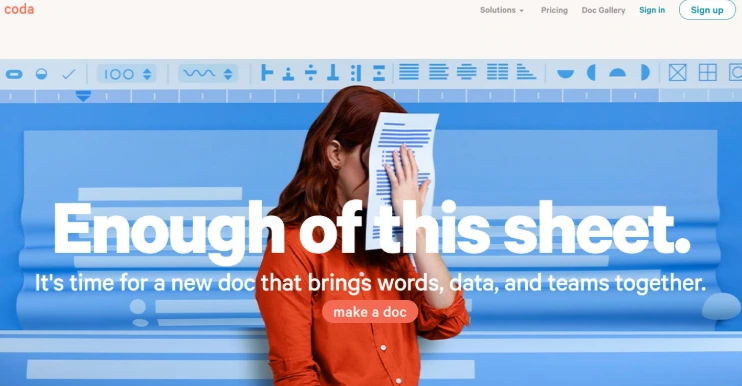
Coda's fix for the blank page problem was simple. In February 2019 Coda 1.0 went live. This first version had a feature that showed what the product can do by turning any doc into a real, browsable website. The team then folded that feature into a Doc Gallery in April 2020, a searchable library of complete templates built by real teams. A prospective user landing on the Gallery didn't read a features list. They saw exactly how Figma ran its product meetings, how Pinterest tracked its OKRs, and how Arianna Huffington used Coda to run mindfulness routines with her own team, cases the company later featured in its own product news. The pitch had become a room full of finished work.
Coda’s co-founder Shishir Mehrotra declared 2020 as the Year of the Maker in order to put more focus on the people who built stuff with their product. And this wasn’t just for show: in October 2021, the company launched the Coda Maker Fund, a $1 million pool to bankroll makers building tools and templates for other makers, paired with a revenue-share affiliate program that let top creators earn directly from what they published. A yearlong certification track, nicknamed the Coda Doctorate, turned the most committed users into a credentialed layer of consultants who carried Coda into client work far beyond anything a sales team could reach alone.
The community team treated these makers as collaborators, not fans. Small signals of belonging like community swag built true loyalty. Coda’s team could then use these loyal power users to gather detailed feedback that allowed them to solve problems way before they ever turned into support tickets. That way, every published doc did triple duty: it onboarded a new user, it functioned as a case study, and it built organic search traffic, all without Coda paying for a single ad. Google Docs and Microsoft had bigger installed bases. But neither had a community actively building and distributing proof of the product for free.

The Community Cashes Out
The strong community Coda had built really paid dividends. Instead of relying on salespeople, they had gotten most of their customers simply because a colleague had shared a doc. This compounded quickly. By 2020, more than 25,000 teams were running on Coda, including DoorDash, Spotify, Uber, and The New York Times. And investors read the trajectory the same way. First, Coda raised an $80 million Series C in August 2020 at a $636 million valuation, then more than doubled that a year later with a $100 million Series D at a $1.4 billion valuation led by the Ontario Teachers' Pension Plan. The jump from mid-market unicorn to a fully validated enterprise platform happened in twelve months, on top of a growth engine that cost almost nothing to run.
By December 2024, Coda was serving more than 50,000 teams, when Grammarly, the AI writing company valued at $13 billion, acquired Coda outright and installed Coda co-founder Shishir Mehrotra as its new chief executive. It isn’t hard to see why the acquisition made sense for Grammarly. It wasn't just buying a codebase but a decade of community trust, and a maker network that had already proven it could turn a hard-to-explain product into durable enterprise revenue.
Since the merger, the numbers keep lining up to Grammarly’s favor: ARR grew from roughly $650 million at the end of 2024 to about $700 million by May 2025, and the company then raised $1 billion in growth financing from General Catalyst to keep scaling. Coda proved that when you’re dealing with a hard-to-explain product, the smartest move isn’t necessarily to keep coming up with a sharper pitch. It’s building a community of happy customers who do the pitching for you. Coda never out-marketed Google Docs or Microsoft Office, and it never had to, because it had community.
Key takeaways
If your product is hard to demo, let users build the demo. Coda's Doc Gallery replaced a features list with real, finished work from Figma, Pinterest, and dozens of other teams. A prospective buyer didn't need a pitch. They needed one example that looked like their own job.
Turn power users into a distribution channel, not just an audience. The Maker Fund, the affiliate program, and the Coda Doctorate certification gave Coda's most devoted users a financial and professional reason to keep bringing new customers in, a sales team that scales without adding headcount.
A decade of community trust is itself an acquirable asset. Grammarly didn't just buy Coda's code. It bought a maker network built over ten years and installed the person who built it as CEO of a combined $13 billion company, proof that community-led growth compounds into something a bigger company will pay a premium for.
By the numbers
$240 million - Total funding raised before acquisition
25,000+ - Teams using Coda by 2020
1 million+ - Users who built on the Coda platform
$1 million - Coda Maker Fund launched in 2021
3 years - Years Coda spent in stealth before public beta
$80 million - Series C funding raised in 2020