Win the Switch
Relevance often begins with understanding why someone is ready for a change.
6 minute readBegin readingZoomInfo didn't win that market with better software. It won by finding the exact buyer who'd already been burned by a rival and putting a sharper answer in front of them first.
Key figure: 10,000
The net-new customers ZoomInfo added between the end of 2020, when it had just crossed 20,000 customers, and mid-2023, when it passed 30,000.
A Market Selling the Same Spreadsheet
In the years before ZoomInfo consolidated the category, the B2B sales intelligence market was a pile-up of vendors selling versions of the same idea: a searchable list of companies and the people who work there. Dun & Bradstreet had Hoovers. Salesforce had Data.com, built on top of Jigsaw, a crowdsourced contact directory it had bought for $142 million in 2010. InsideView, RainKing, DiscoverOrg, and Zoom Information were all chasing the same accounts, and LinkedIn Sales Navigator, riding LinkedIn's own professional graph, was the biggest of the bunch.
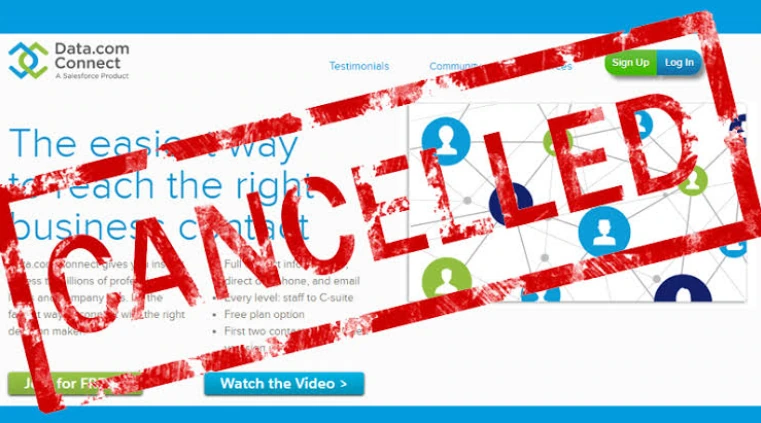
The product these companies sold had a defect that was invisible at the point of sale. Contact data rots the moment a person switches jobs, and a buyer had no way to test "most accurate" before signing a contract. They found out three months in, when a sales rep's emails started bouncing. Salesforce's own version of this problem became terminal: Jigsaw's model paid users in credits for uploading contacts, which meant the fastest way to earn credits was dumping in whatever data you had, accurate or not. By 2019 Salesforce was winding the product down entirely, having quietly concluded the underlying data was "too weak to be sold."
That defect made the market strange. Whoever led on customer count didn't necessarily have better data, they'd simply won more of the land grab. Real differentiation only showed up after the sale, in bounce rates and stale org charts, which is exactly the kind of information that spreads through reviews and word of mouth rather than a spec sheet. And the category was still wide open: ZoomInfo's own market sizing, filed with regulators the year it went public, put its addressable market near $30 billion across 750,000 potential business customers, against a company that, at the time, had only signed up about 2% of them. Whoever built the fastest way to catch a buyer already souring on a rival stood to eat that entire market, one disappointed customer at a time.
Buy the Rival, Then Advertise Against the Next One
Henry Schuck founded DiscoverOrg in 2007 on a bet against exactly the crowdsourced model that would later sink Data.com. Instead of scraping or crowdsourcing, DiscoverOrg hired dozens of researchers to call directly into IT and finance departments and verify org charts by hand, an approach Schuck later called "innovation through dis-innovation." It was slower to build and it worked: accuracy became the entire pitch against a market full of decaying spreadsheets.
Once that pitch was proven, Schuck stopped competing with rivals and started buying them. First on the menu was DiscoverOrg’s most direct competitor in tech sales intelligence, RainKing. Next up was Zoom Information itself, which was acquired for roughly $800 million in February 2019, taking the combined company to nearly 15,000 customers and 120,000 active users overnight, and vaulting past every rival except LinkedIn Sales Navigator. Each deal didn't just remove a competitor, but it imported that competitor's entire customer list directly into ZoomInfo's funnel before a single ad ever ran.
Advertising came next, and it wasn't generic branding. ZoomInfo created a library of pages, each built around a gap in a rival's product, like: Apollo's divided opinions on data accuracy, Lusha's lack of buying-intent signals, Cognism's dependence on third-party intent data, or LinkedIn Sales Navigator's absence of direct phone numbers. Instead of "we're better," the pitch was "here's exactly where the tool you're using falls short, and here's what to do about it," aimed at whoever was already searching for an alternative.
Then, in October 2020, ZoomInfo bought a small behavioral intent-data company called Clickagy, folding its targeting engine straight into ZoomInfo's own advertising product. The company's innovation lead described the shift as going from "0 to 60 mph almost overnight" on advertising sophistication. ZoomInfo could now see, close to real time, which specific companies were actively researching a competitor's product, and put a comparison ad or landing page in front of the buyer before a rival's sales team ever got the lead. By the time ZoomInfo ran its first traditional brand campaign in mid 2023, the comparison machine had already helped carry the company from roughly 20,000 to 30,000 customers without it.

Biggest Fish, Slower Water
ZoomInfo grew significantly over the years, both in terms of customers and revenue. By 2025, the number of customers had grown to over 35,000 from approximately 11,000 in 2018, while revenue grew from $293.3 million in 2019 to $1.24 billion by 2023. In June 2020, ZoomInfo went public at $21 a share and closed its first day up 62%, marking the biggest U.S. tech debut of that pandemic year. By 2025, the comparison-and-intent machine had produced an outside validation too: 133 No. 1 rankings in G2's crowdsourced buyer-review reports, the exact review ecosystem the whole strategy had been built to win.
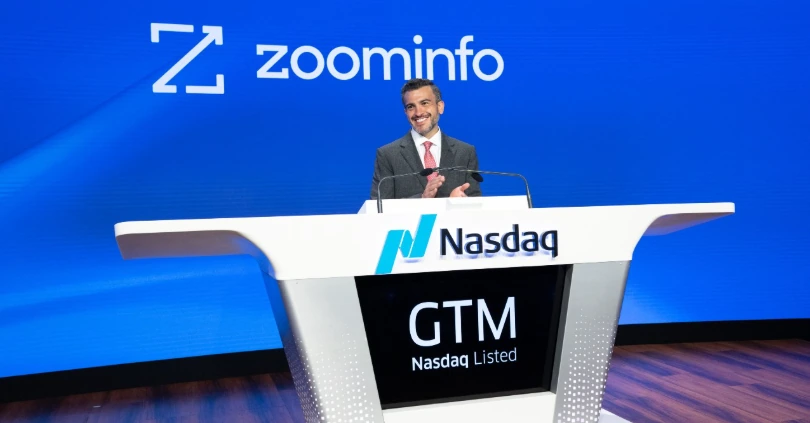
But the tactic had a shelf life. Once the entire category learned to run the same "versus" pages back at ZoomInfo, being the aggressor stopped being an edge and became table stakes. Growth slowed at first, and then reversed: 2024 revenue fell 2% to $1.21 billion, its first annual decline, and net revenue retention slid from 108% in 2020 to 87%. In May 2025, the company changed its own Nasdaq ticker from ZI to GTM, an admission that "biggest data company" was no longer a wide enough moat on its own. By mid-2026 the stock had fallen more than 70% from its highs on weak guidance and slowing demand.
None of that erases what the original strategy proved. ZoomInfo didn't grow by claiming to have the best data, an unprovable pitch in a market where quality only shows up after the invoice. It grew by finding the buyer who already knew a competitor's weak spot and getting there first. That machine is still the largest in its category. It's just no longer the only one running.
Key takeaways
When quality is invisible until after the sale, comparison content is the actual pitch. Nobody can verify "most accurate data" from a spec sheet, so the buyer's real evidence is a bounce rate they haven't hit yet. ZoomInfo built its entire growth engine around being the answer to a complaint the buyer hadn't voiced out loud yet.
Acquiring a rival's customer book is only half the move. Buying RainKing and Zoom Information handed ZoomInfo thousands of accounts overnight, but pairing that with an intent-data engine that could spot a buyer mid-defection is what turned two acquisitions into a decade of compounding growth.
A tactic every competitor can copy has a shelf life. Being first to run the comparison ad was worth more than perfecting it, because once Apollo, Cognism, and Lusha started publishing the same "versus" pages back, the advantage stopped being structural and became just another cost of staying in the category.
By the numbers
$30 billion - Estimated total addressable market in 2020
35,000+ - Customer growth from 2018 to 2025
$1.24 billion - Revenue growth in 2023
$935 million - Capital raised in the IPO
87% - Net revenue retention in 2024
$800 million - DiscoverOrg acquisition price for Zoom Information